
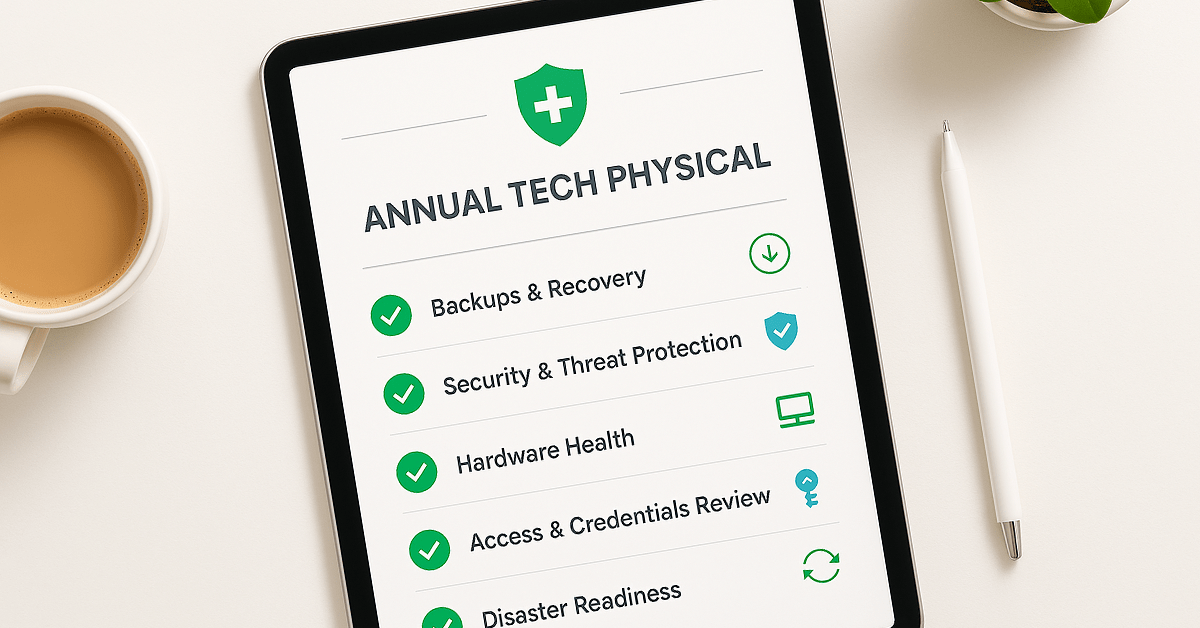
January is the month people finally schedule the things they’ve been avoiding.
Doctor appointments. Dentist visits. Maybe even getting that strange noise in the car checked out.
Preventive care isn’t exciting—but it’s a lot less painful than dealing with a preventable disaster.
So here’s the uncomfortable question:
When was the last time your business technology got a real checkup?
Not “we fixed the printer last week.”
Not “IT put out a fire.”
An actual health exam.
Because working and healthy are two very different things.
The “I Feel Fine” Trap
Most people skip annual physicals because nothing hurts.
Businesses skip technology assessments for the same reason:
- “Everything’s running.”
- “We’re slammed right now.”
- “We’ll deal with it when something breaks.”
The problem?
Technology issues rarely announce themselves.
High blood pressure doesn’t hurt—until it does.
A cavity doesn’t hurt—until it becomes an emergency.
IT failures follow the same pattern.
The issues that take down businesses are almost always:
- Known risks that went unchecked
- Aging equipment that was “fine” until it wasn’t
- Backups that existed but didn’t restore
- Access that was never reviewed
- Compliance gaps no one thought to look for
A system can run every day and still be one bad moment away from disaster.
What a Real IT Physical Actually Examines
A proper technology assessment looks at your environment the way a doctor looks at your body—systematically, and with an eye for problems you can’t see yourself.
Vital Signs: Backup and Recovery
This is the heartbeat of your technology health.
- Are backups actually completing—not just scheduled?
- When was the last time a restore was tested?
- If a critical system failed at 9 a.m. on a Monday, how long before you’d be operational again?
Most businesses only discover backup failures during an emergency.
That’s like finding out your airbags don’t work during the crash.
Heart Health: Hardware and Infrastructure
Technology doesn’t fail politely. It degrades, loses support, slows down—and then dies at the worst possible time.
- How old are your servers, firewalls, and workstations?
- Is any core equipment past manufacturer support?
- Are replacements planned—or are you running things until they fail?
Aging hardware is one of the most common hidden causes of downtime. It doesn’t stop suddenly—it quietly becomes a liability.
Bloodwork: Access and Credentials
If you can’t clearly answer who has access to what, you’re overdue.
- Can you generate a list of all active users today?
- Are former employees or old vendors still enabled?
- Are shared accounts hiding accountability gaps?
Access creep doesn’t happen because businesses are careless—it happens because no one has time to clean it up.
Cancer Screening: Disaster Readiness
Nobody likes thinking about worst-case scenarios. That’s exactly why they matter.
- If ransomware hit tomorrow, what’s the real plan?
- Is it documented—and has it ever been tested?
- How long could your business function without core systems?
“If it happens, we’ll figure it out” isn’t a plan.
It’s a gamble.
Specialist Referrals: Compliance & Industry Requirements
In many industries, “healthy” has a definition set by someone else.
- Healthcare organizations must meet HIPAA requirements
- Businesses handling credit cards must pass PCI compliance
- Client contracts increasingly include security and audit clauses
Generic IT advice doesn’t cut it. Your environment needs to be evaluated in the context of how your business actually operates.
Warning Signs You’re Overdue
If any of these sound familiar, it’s time:
- “I think our backups are working.”
- “The server is old, but it still runs.”
- “We probably have former employees still in the system.”
- “Our disaster plan is… somewhere.”
- “If that one person left, we’d be in trouble.”
- “We’d probably fail an audit—if anyone checked.”
Those aren’t minor concerns. They’re early symptoms.
The Real Cost of Skipping Preventive Care
An IT checkup costs hours.
An IT failure costs days—or weeks.
Consider the impact:
- Data loss: Client records, financial data, and operational files may never be recovered
- Downtime: Lost productivity, delayed deliverables, damaged client trust
- Compliance penalties: Fines, audits, and potential loss of payment processing
- Ransomware: Recovery costs routinely reach six figures for small and mid-sized businesses
Prevention is boring—and affordable.
Recovery is expensive, stressful, and public.
Why You Can’t Diagnose Yourself
You wouldn’t perform your own physical and declare yourself healthy.
Technology is no different.
An effective assessment requires someone who:
- Knows what “healthy” looks like for businesses your size and industry
- Has seen failure patterns across many environments
- Can spot risks you’ve normalized because you live with them every day
That’s prevention—not firefighting.
Schedule Your Annual IT Physical
It’s January. You’re already booking preventive care.
Add this one to the list.
Schedule an Annual Tech Physical and get a clear, plain-English health report:
- What’s working
- What’s at risk
- What needs attention before it becomes an emergency
No jargon. No pressure. Just clarity.
Because the best time to catch a problem is before it becomes one.
And that time is now.